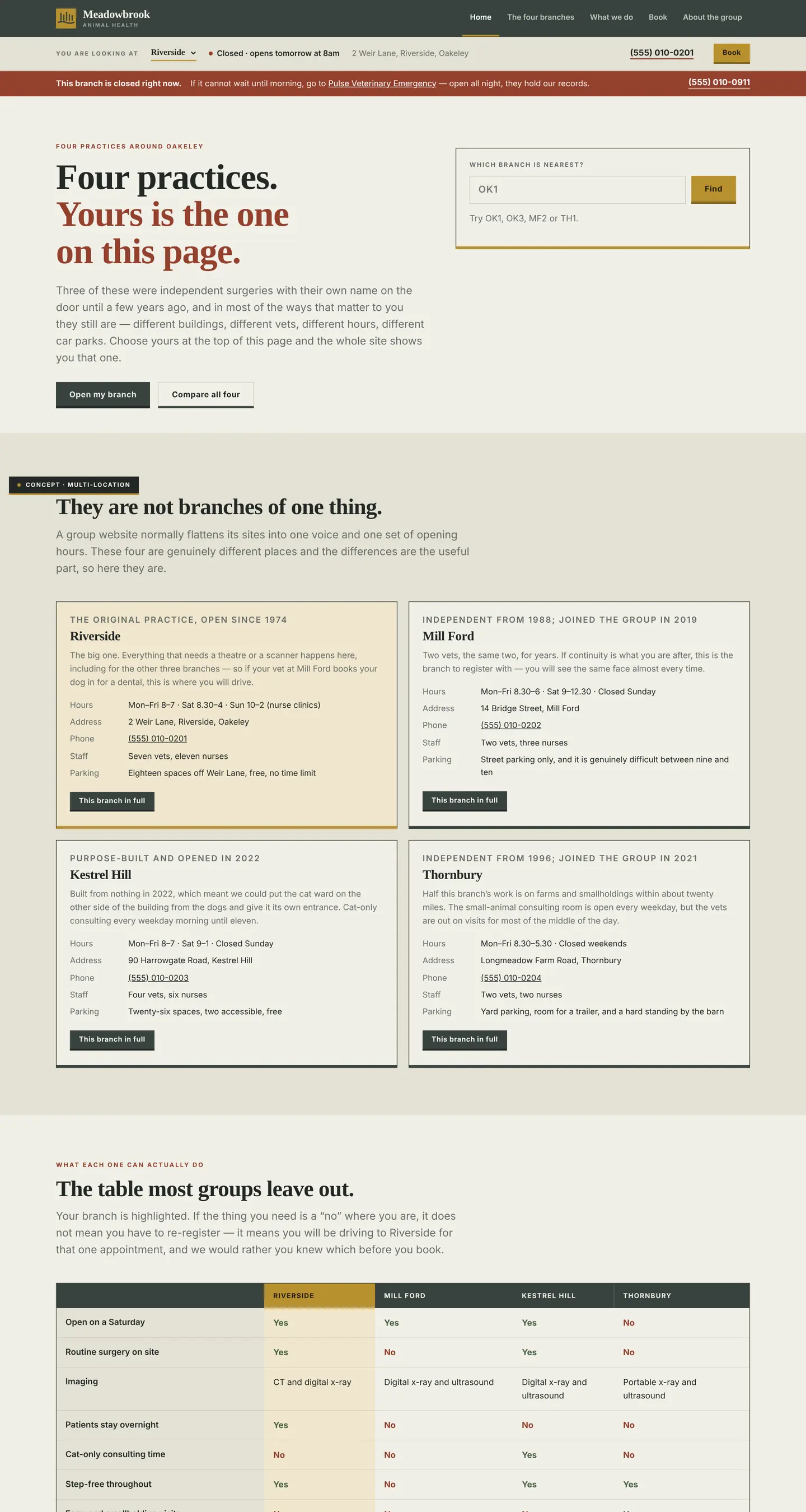
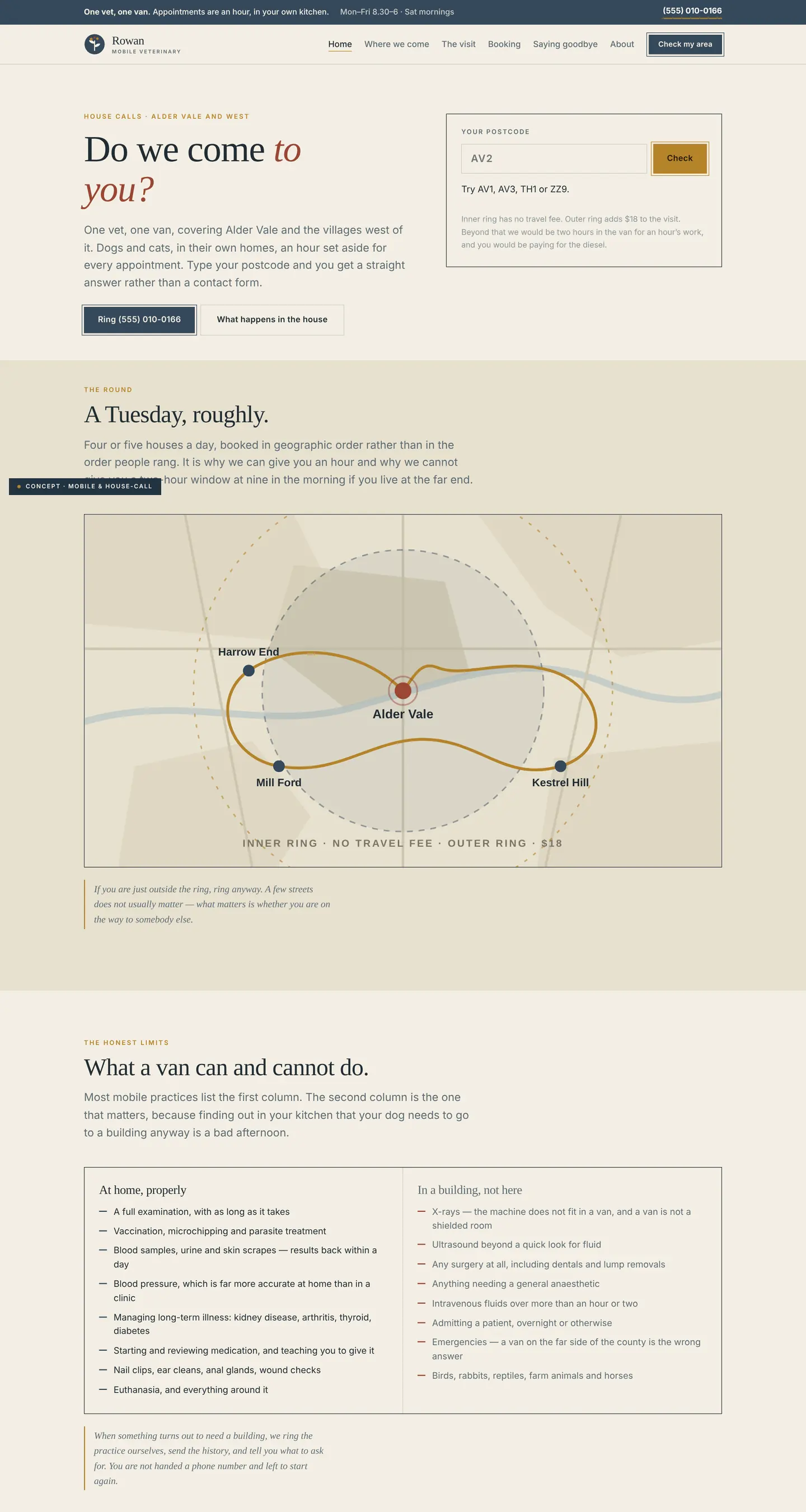
Veterinary clinics only. One person, start to finish.

Your clinic’s website has one job at 11:47 PM.

Every page is planned around one person: someone whose pet is sick, on a phone, late at night, deciding who to call. No templates borrowed from restaurants or law firms.

Your website's hardest shift starts after you've gone home.

You own your domain and hosting from day oneOne fixed quote, no surprises

The problem

What generalist agencies say. What it means for your clinic.

If you've talked to a web agency before, you've heard these lines. Here's what each one turns into once the site is live.

“We build websites for businesses of every size.”
Your clinic gets the same layout as the pizza place down the street. Nobody planned it around a worried pet owner, so the page answers questions nobody at 11 PM is asking.
“It'll look modern and clean.”
Modern isn't the point; trust is. A worried owner decides in under a second whether your site looks like a place they'd bring their dog. If it doesn't, they never get as far as your hours.
“Just send us your content and we'll drop it in.”
Copy written between appointments gets pasted into a template. Nobody decides what an anxious owner reads first, second, and third.
“Don't worry, we'll take care of the domain and hosting.”
Check whose name they're under. If it isn't yours, leaving gets expensive, and your reviews and content leave with them.
“We'll get you to the top of Google.”
Nobody can promise that. What can be done is a complete Google Business Profile, local schema, and pages that answer what pet owners actually search, set up right at launch.


How every site is planned

Nobody browses a vet’s website.

Most people who land on a vet clinic's website aren't browsing. Something is wrong, it's late, and they're deciding who to call. Every site we build is planned around that moment, in three steps.

01Found

When they search, your clinic shows up.

Show up when a pet owner searches “24 hour vet near me” at midnight — and when they ask ChatGPT the same question. Google Business Profile, local schema, review integration, and pages structured so assistants can answer from them, set up once, right, at launch.

Your hours, services and the animals you treat are written so search engines and maps can read them, not buried in an image.

02Trusted

They trust you in the first five seconds.

An anxious visitor decides whether to trust your clinic before they've read a word of copy. Three things have to register, in this order:

  1. 1Proof you're open and reachable: hours and a tap-to-call number up top.
  2. 2Proof a real, caring practice is on the other end: a real photo of your team.
  3. 3One obvious next step, not four buttons competing for attention.

03Booked

They book, even while you're closed.

Tap-to-call in the header, a booking button that stays put, and a request form that works at 2 AM. The visitor who would have moved on to the next result leaves a request instead, and your front desk starts the morning with it.

Every page points to the same action. No competing buttons, no dead ends.

One week, as it actually arrives

Your front desk is open forty hours. Your website isn’t.

One week in a clinic’s calendar. The faint blocks are the appointments your front desk took over the phone. The filled ones came in on their own, while the lights were off — each with the time the request arrived.

Today ‹› October 2026 Week
—

One week at a clinic that takes bookings online.

0 booked during opening hours 0 requested while closed

The split above is not invented for the animation: Vetfluence sets it to match the figure Vetstoria reports across its own clinic network, where 42% of appointments booked through the platform were made outside practice hours. Meanwhile the AVMA’s 2025 economic report puts online scheduling in only 33.4% of practices as of 2024. Two-thirds of clinics are shut to that demand entirely.

Services

What we build.

Emergency, exotics and multi-location practices get a different page order out of the same four services. See what changes for your kind of practice →

Optional add-on: Local SEO setup.Google Business Profile, local schema, and review integration, set up at launch.Details →

  1. 01Custom designno templates
  2. 02Copy and page orderfor anxious owners
  3. 03Mobile-first build
  4. 04Hours and tap-to-call up top
  5. 05One booking action, every page
  6. 06Species and services, findable
  7. 07Google Business Profileadd-on
  8. 08Local schema and reviewsadd-on
  9. 09Hosting, backups, security
  10. 10Content changes after launch

All of it, one person

One point of contact.

The person who takes your first call designs your site, writes your copy, and answers the phone after launch. No account manager, no hand-offs.

Why the whole site matters

The basics get you called. Trust gets you chosen.

A worried owner gives a clinic’s website three chances to earn their trust, in this order. Fail the first and they never reach your hours.

  1. 01

    Under a second

    The first glance

    Does this look like a real, caring practice? People judge how a page looks within about a twentieth of a second. A dated or cheap-looking site gets closed before anyone reads that you are open.

  2. 02

    The next thirty seconds

    The scroll

    Each section answers the next worry in the order it comes: can you treat my animal, who will see them, have other owners been happy, what happens when we arrive. A page that flows earns a little more trust with every screen — like the one you are scrolling now.

  3. 03

    The last tap

    The decision

    Open now, a number to tap, one button to book. This is the part a few quick fixes can cover. The first two are what a full, trust-first redesign adds.

Visual appeal judged within 50 milliseconds: Lindgaard et al., Behaviour & Information Technology, 2006. In Stanford’s study of 2,684 people judging 100 websites, a site’s design look was the most-mentioned credibility factor, in 46.1% of their comments: Fogg et al., 2003.

Process

From first call to launch, in 3–5 weeks.

You see the site taking shape at every step. No black box, no surprise reveal at the end.

  1. 01Day 1

    Discover

    A conversation about your clinic and what's actually stopping pet owners from calling. No boilerplate discovery deck.

  2. 02Week 1

    Design

    We map what a worried pet owner needs to see first, second and third, before a single page gets designed.

  3. 03Weeks 2–4

    Build

    Copy, photos and layout, built together from the same source, so nothing feels bolted on after the fact.

  4. 04Weeks 3–5

    Launch

    It goes live and it's yours: your domain, your hosting, your content.

  5. 05After launch

    Support

    We stay on as your point of contact for updates, fixes, and the occasional “is the site down?” text.

See the week-by-week timeline →

Why vets only

The specialist, not the generalist.

A generalist web agency

  • Builds sites for restaurants, law firms, dentists, and everyone in between
  • Learns your industry on your dime
  • Uses stock photography that could belong to any business
  • One project among hundreds, in a queue

Vetfluence

  • Builds nothing but veterinary clinic websites
  • Already understands clinic workflows, anxious-owner psychology, and vet-specific content
  • Every layout decision is built around calming a worried pet owner
  • One point of contact, from first call to launch

A handful of agencies build only for vets. One of them is a single person who plans your pages, writes your copy, builds the site, and picks up the phone afterwards — with nothing on this website that didn’t actually happen.

42%

of appointments booked through one major veterinary booking platform were made outside practice hours.

Vetstoria, across its own clinic network, 2021
33.4%

of practices used online appointment scheduling in 2024. Two-thirds of clinics are shut to anyone who won’t phone.

AVMA Economic State of the Profession, 2025
78%

of pet owners rate being able to book any time, on any device as important.

PetDesk Pet Parent Research Report, 2025, n=1,000
3–5

weeks from first call to launch on a typical new build, with two full rounds of revisions.

Vetfluence

Three of these four are vendors reporting on their own customers, so they are labelled that way rather than dressed up as industry fact. The AVMA figure is the independent one. An agency that is careful with other people’s numbers is easier to believe about its own.

Free · no email required

“How many of these ten does my clinic's site pass?”

Ten specific, testable things to check on your own site, in about five minutes. Pull it up on your phone and go through it live.

Open the checklist

Want to know what your site is losing at 11 PM?

Fifteen minutes, no deck, no follow-up sequence. You’ll get a straight answer about your current site whether or not you hire me.

You own your domain and hosting from day oneOne fixed quote, no surprises